
San Francisco Architect Insurance

The Benefits of Working with an Experienced Broker

San Francisco Architect Insurance

San Francisco architect insurance is complex. From high-value construction projects, to seismic risks, to aggressive litigation trends, Bay Area architecture firms often discover that finding the right insurance is far more complicated than purchasing a standard business policy online.

That is why working with an experienced insurance broker who understands architect insurance — and the San Francisco market specifically — can make a major difference in both protection and long-term business stability.

Unique Risks for San Francisco Architects

Architects carry professional responsibilities that create exposures beyond those of many other businesses. Even a small design oversight can lead to allegations of:

  • Construction delays
  • Cost overruns
  • Structural deficiencies
  • ADA compliance issues
  • Water intrusion or building envelope failures
  • Life safety concerns
  • Contract disputes between project stakeholders

In California, and particularly in the Bay Area, claims involving construction defects and professional negligence can become extremely expensive. A single lawsuit can involve developers, engineers, contractors, subcontractors, and architects all at once.

An experienced broker understands these risks and helps structure policies that address the real-world exposures architects encounter every day.

Professional Liability Coverage is Critical

The centerpiece of most architect insurance programs is professional liability insurance, also known as errors and omissions (E&O) coverage. This coverage helps protect architects when claims arise alleging negligence, design errors, omissions, or failure to meet professional standards.

However, professional liability policies are highly nuanced. Coverage differences between carriers can include:

  • Contract review provisions
  • Defense costs inside vs. outside limits
  • Pollution exclusions
  • Cyber-related design exposures
  • Coverage for subcontracted consultants
  • Prior acts coverage
  • Project-specific exclusions
  • Residential construction limitations

A generalist insurance agent may not recognize these distinctions. An experienced architect insurance broker can compare policy language carefully and explain how different carriers approach risk.

This becomes especially important in San Francisco, where many projects involve mixed-use developments, historic renovations, multifamily housing, complex urban construction, and extremely high construction costs.

San Francisco Construction Risks are Unique

The Bay Area presents challenges that are not always present elsewhere in the country.

Some of the most important include:

Seismic Exposure

Earthquake risk affects nearly every aspect of construction and design in the region. Insurers may scrutinize firms involved in structural work or large commercial projects more heavily than firms in lower-risk regions.

Dense Urban Development

San Francisco projects often involve tight construction sites, neighboring property exposures, and extensive permitting requirements. These conditions can increase the likelihood of disputes and claims.

High Construction Costs

Construction defect claims in the Bay Area can become extremely expensive simply because labor and material costs are so high. Even relatively small issues can lead to six-figure losses.

Evolving Regulations

California building standards, energy regulations, accessibility requirements, and environmental rules continue to evolve. Architects must stay compliant while also protecting themselves contractually.

A broker who regularly works with architects in California is far more likely to anticipate these challenges before they become insurance problems.

The Importance of Contract Review

One of the biggest mistakes architects make is focusing only on the insurance certificate instead of the underlying contract language.

Project contracts frequently include problematic provisions such as:

  • Broad indemnification clauses
  • Unrealistic standards of care
  • Duty-to-defend requirements
  • Uninsurable guarantees or warranties
  • Excessive insurance requirements

An experienced broker who specializes in architect insurance can help firms negotiate more reasonable terms before signing agreements.

Architects Often Need Multiple Policies

Professional liability insurance is only one piece of a complete insurance program.

Depending on the firm’s size and operations, architects may also need:

  • General liability insurance
  • Cyber liability coverage
  • Workers’ compensation
  • Commercial auto insurance
  • Employment practices liability insurance (EPLI)
  • Umbrella liability coverage

An experienced broker helps coordinate these policies so that your firm does not have critical coverage gaps. At Mighty Oak, we are experts in all the types of policies recommended by the American Institute of Architects (AIA).

A Cheap Policy can become an Expensive Mistake

Many architects understandably try to control insurance costs, particularly smaller firms and independent practitioners. But choosing coverage based solely on price can create serious problems later.

Lower-cost policies sometimes contain:

  • Restrictive exclusions
  • Lower-quality claims handling
  • Limited defense coverage
  • Reduced coverage for residential work
  • Narrow definitions of professional services

When a claim occurs, those differences matter enormously. An experienced broker helps architects evaluate value — not just premium.

Claims Advocacy Matters

One of the most overlooked benefits of working with a knowledgeable broker is claims support.

When professional liability claims arise, architects often face stressful situations involving attorneys, project owners, contractors, and deadlines. A broker who understands architect claims can help:

  • Report claims properly
  • Coordinate with carriers
  • Preserve coverage
  • Assist with documentation
  • Advocate during disputes

That guidance can be invaluable during a high-pressure claim.

Choosing the Right Insurance Partner

Not every insurance broker understands design professionals. Architects should look for brokers who:

  • Regularly work with architecture and engineering firms
  • Understand California construction risk
  • Have access to multiple professional liability markets
  • Review contracts and risk exposures
  • Understand project-specific coverage needs
  • Can explain policy language clearly

In a market as complex as San Francisco, experience matters. Here at Mighty Oak, we have this experience. We do more than sell insurance policies. We become long-term risk management partners who help protect the reputation, finances, and future of your architecture firm. Our specialty is San Francisco architect insurance so that your don’t have to. Let your broker focus on your insurance, so that you can focus on your work.


Contact a broker today to get started!

Apartment Building Insurance on the Bay Area Peninsula

Apartment Insurance Bay Area Peninsula

Finding apartment building insurance on the Bay Area peninsula—stretching from San Bruno to San Mateo and down through Silicon Valley—has become increasingly difficult. What was once a relatively routine line item for property owners has evolved into one of the most unpredictable aspects of multifamily ownership. Read on to learn why apartment insurance has become more challenging in the Bay Area, and how we can help you solve it.

The Apartment Building Insurance Squeeze on the Bay Area Peninsula

Here are some of the main problems owners of Bay Area apartment buildings face when they try to obtain insurance for their buildings:

A Shrinking Market

At the core of the problem is a shrinking pool of insurers willing to write policies in California. Over the past several years, major carriers have either exited the market or sharply limited new underwriting, particularly for habitational property risks.

This retreat is driven by a mismatch between risk and pricing. Catastrophic losses, especially from wildfires, have increased dramatically in California, while California’s regulatory framework has historically limited insurers’ ability to quickly raise premiums. As a result, many insurers have concluded they simply cannot operate profitably and have reduced exposure by declining new policies or non-renewing existing ones. For apartment owners on the peninsula, this means fewer quotes, longer placement times, and far less negotiating leverage.

High Prices

Where insurance is still available, it is often dramatically more expensive. Premium increases of 2–3x from year to year are no longer unusual, and some property owners report even steeper jumps. Part of this is due to rate hikes that have affected the entire industry, but that’s not the whole picture. The Bay Area peninsula is one of the most expensive places to live in America, and insurers raise their prices to account for that.

Additionally, high reconstruction costs in the Bay Area amplify insurer exposure. Labor, materials, and regulatory compliance all make rebuilding significantly more expensive than in other parts of the country, raising the stakes for insurers and pushing premiums higher. All of this leads to high prices for the insurance consumer (the apartment building owner).

Worse Coverage

Multifamily owners face an additional complication: even as premiums rise, coverage is often becoming narrower. Policies may come with:

  • Higher deductibles
  • Difficulty obtaining additional coverages like Ordinance and Law (often required by mortgage companies)
  • Exclusions for certain perils (water damage, wrongful eviction, habitability claims, etc.)

If the apartment building has older wiring or a roof in need of maintenance, the insurance options become even more limit. Many apartment buildings that used to be able to find high quality insurance for a low price are now forced to purchase a Fair Plan policy instead.

The FAIR Plan has grown rapidly, more than doubling in recent years. But it offers limited, bare-bones coverage and often requires additional “wrap-around” policies to fill gaps. These layered structures can be expensive and cumbersome, particularly for larger or more complex apartment buildings. For peninsula properties, many of which are high-value assets, the mismatch between FAIR Plan coverage and actual replacement costs can create significant exposure.

Navigating a Difficult Landscape

In this environment, apartment owners on the peninsula must take a proactive and strategic approach to insurance. Common strategies include:

Investing in building upgrades

One of the most straight-forward paths to obtaining lower-cost, high quality insurance for an apartment building is to keep up with regular maintenance. Most insurers expect that the roof, electrical, plumbing, and HVAC systems get renovated (or at least thoroughly inspected) every 25-30 years. Old and obsolete electrical systems (such as knob and tube, aluminum wiring, Federal Pacific breakers, Challenger breakers, Zinsco breakers) will force many insurers to decline, or offer high-priced policies. But if the building systems are up-to-date and well-maintained, even older buildings (built 1900, for example) can often get competitive insurance pricing.

Working with specialized brokers who understand multifamily risk

Our specialty is property insurance in California, specifically on the Bay Area peninsula (where we live). We are local experts who know the intricacies of the local insurance market. Our connections in the industry allow us to find insurers that other brokers don’t know about, and our intimate understanding of the Bay Area provides us with insight that out-of-state brokers lack. We know how to help Bay Area apartment building owners find the most competitive pricing, and we know how to help them keep their pricing low into the future.

Regularly re-shopping coverage in a volatile market

The market is always shifting, so it makes sense to shop around every year, especially if your pricing is high. Sometimes an apartment building has to take on an expensive policy due to deferred maintenance or a history of claims, but that doesn’t mean that owner needs to stick with the same policy forever. Each year we will shop around to make sure you always get the most competitive pricing. We are always looking out for the carriers that lower their rates, and we make the transition to a new insurer seamless.

Conclusion

The difficulty of securing apartment building insurance in the Bay Area peninsula is not a temporary disruption. Driven by climate change, inflation, and regulatory issues, the high prices reflect a structural shift in how the California insurance market functions. But we can help! Our core area of expertise is helping apartment building owners in the Bay Area peninsula. Our on-the-ground knowledge of the Bay Area and our deep connections in the insurance industry combine to make us the ideal ally for a building owner. We can also help Bay Area HOAs too!

Reach out today to get a quote!

Bar Insurance in California

bar insurance in california

Operating a bar is challenging enough. But for venues that are 100% alcohol with no food sales, securing insurance can be unexpectedly tricky. These establishments are viewed by insurers as higher-risk operations, which narrows the pool of available carriers and drives up premiums. But we can help! Here is how to find bar insurance in California.

Why Bars Are Hard to Insure

Insurance companies evaluate risk based on how much alcohol is served and consumed. Bars without food are often seen as presenting a greater likelihood of overconsumption, intoxication, and late-night incidents. As a result, insurers frequently charge more—or decline coverage altogether—because alcohol-related claims can be severe and costly.

Liquor-related incidents—such as fights, injuries, or drunk driving accidents—can expose a bar to lawsuits claiming the bar should be held liable for harm caused by intoxicated patrons. For this reason, many big-name insurers have stopped offering policies to bars altogether.

If your business makes 100% of its revenue from alcohol sales (no food sales), that trend is even more pronounced, because insurers tend to favor businesses that generate a meaningful portion of revenue from food. Many insurers will also refuse to insure bars that employ security guards or bouncers due to an increased risk of physical altercations.


Core Insurance Coverages Required

Bars in California typically need a package of coverages, not just a single policy. The most critical include:

1. Liquor Liability Insurance
This is the cornerstone policy for any alcohol-serving establishment. It covers legal fees, settlements, and damages if a patron causes injury or property damage after being served alcohol. This coverage is not included in general liability policies, leaving businesses exposed if they don’t purchase it separately. It may also be a requirement in your lease, or from a licensing body.

2. General Liability Insurance
Covers non-alcohol-related incidents such as slips and falls and injuries occurring on the premises. Your broker should also make sure that Assault and Battery Coverage is included on the policy, in case a fight breaks out on the premises.

3. Property Insurance
Protects the physical bar, equipment, and inventory from risks like fire, theft, or vandalism.

4. Workers’ Compensation
Required in California for any business that hires employees. This covers all varieties of workplace injury.

5. Excess / Umbrella Liability
Many landlords and licensing bodies require higher limits through umbrella policies, in case a claim exceeds $1m.


Why Specialized Brokers Matter

Because of the complexity and shrinking insurance market, it is crucial to work with a broker who specializes in bars and nightlife. At Mighty Oak, we specialize in tough-to-place insurance, including bar insurance in California.

We know how to:

  • Access niche carriers that still write liquor-heavy risks
  • Structure policies to avoid dangerous coverage gaps (e.g., liquor liability or assault & battery exclusions)
  • Present your business in the best possible light to underwriters (emphasize your training programs, employee safety, security, operations)
  • If your carrier non-renews your policy for any reason, we can efficiently replace it with a new carrier.
  • Shop around for you to ensure that you are always paying the most competitive price, while still getting the coverage you need.

Without that expertise, bar owners can easily end up either underinsured (and exposed to lawsuits) or overpaying for inadequate coverage. Insurance for alcohol-serving businesses is not a simple checkbox—it’s a highly technical, evolving part of the industry. One misstep can leave a business financially vulnerable.


Contact Us

Bar insurance in California can be difficult to obtain, but we are here to help! Though there might be fewer options, stricter underwriting, and higher costs, we know how to get it done right and for a fair price.

Contact us to learn more or get quotes!

How to properly insure a restaurant with bottle service or high liquor sales

If you operate a restaurant where bottle service or high liquor sales are a key part of your concept, you may find it more challenging to find insurance. While standard restaurants can often acquire low-cost insurance from big-name insurers, restaurants with bottle service or high liquor sales are regularly declined by these same carriers. But it certainly is not impossible for such restaurants to find good insurance! You just have to work with a broker who knows how to get it done.

Why is it more challenging to find insurance for a restaurant with bottle service or high liquor sales?

Insurance companies don’t really care about the word “restaurant”, they care about risk profile. And bottle service pushes you toward a riskier category in their eyes. Insurers rank restaurants along this scale:

  • standard restaurants (least risky)
  • bars (medium risk)
  • night clubs (riskiest)

Insurers (especially the standard, big-name insurers that usually offer low-cost insurance to restaurants) will often group restaurants that offer bottle service into the “night club” category, even if the restaurant is not a night club. These insurers are concerned that bottle service or high liquor sales will lead to more frequent claims stemming from intoxicated clients, late-night activity, security incidents, etc. These insurers are nervous about this even if your restaurant is up-scale, well-managed, and completely safe. For this reason, many of these insurers will simply decline on the front-end.

Oftentimes brokers who are less experienced in commercial insurance will only apply with these conservative, big-name insurers. When these carriers inevitably refuse to send a quote, the broker reports to the restaurant owner that there just aren’t any insurance options available. But this is not the case! There are many insurers that specialize in just this type of restaurant. You just need to work with a broker who knows where to look.

How to properly insure a restaurant with bottle service or high liquor sales

1) Know where to look.

Here at Mighty Oak we specialize in insuring business owners who would normally struggle to find insurance. This means that we know to look beyond the big-name insurers (who are very good at saying “no”) and instead explore the broader insurance market, which includes insurers that specialize in all varieties of restaurant insurance, from bars to Michelin Star restaurants to nightclubs, and everything in between. Our contacts with underwriters at a wide variety of insurers allows us to move quickly, so that your restaurant opening is not delayed due a failure to acquire insurance in a timely fashion. And though it’s true that restaurants with bottle service are likely to pay more for insurance than a pizza shop, we will always shop around to make sure you get the most competitive pricing available!

2) Know which coverages are crucial.

A standard “Business Owner Policy” for a restaurant will automatically include liability coverage, and will insure the contents of the restaurant (furniture, computers, food). This is a great start, but it isn’t the whole picture. For a restaurant offering bottle service, “liquor liability” is a critical part of the policy that many brokers will overlook. This coverage specifically insures your business in the event a claim stems from an intoxicated client. Making sure the policy includes this coverage prevents the carrier from denying a liquor-related claim.

Another important coverage to look for is “assault and battery coverage”. In the event (for example) a rowdy client picks a fight with a staff member, assault and battery coverage can pay for your business’s legal defense, medical bills, and settlements. This is a crucial coverage for establishments with high liquor sales, as well as restaurants that employ security or operate in higher-risk areas. You need to work with a broker who knows to add these features to your policy.

Bottom line

It is certainly not impossible to find insurance for a restaurant offering bottle service. Yes liquor sales, a late-night crowd, and the location are all factors that might make finding insurance more challenging (especially for less-experienced brokers), we know how to navigate this market and get your restaurant insured. And we won’t offer you a quick policy that’s missing key ingredients, because our primary concern is to make sure your business is insured properly. We know where to find the right policies, we know what to look for in these policies, and we know how to explain the coverages in a simple and straightforward way so you know what you’re buying.

Reach out today to get quotes!

How to Properly Insure a General Contractor

There is no gentle way to say it: general contractors need to make sure they are properly insured. Below is a crash course on general contractor insurance: the types of policies you might need, and what to look for in those policies.

Proper contractor insurance isn’t just about having a policy that satisfies a client’s insurance requirements on paper. Real insurance means having policies that will actually pay when an accident happens: if an employee falls off a ladder and can’t work for months, if an uninvited visitor wanders onto your job site and gets injured, if a disconnected sump pump causes an unexpected flood, or if some other accident opens your business up to a costly lawsuit. And it means having a broker who has reviewed every exclusion in your policy, so you know exactly what is covered and what is not.

Here is a handy guide on how to make sure your construction business is properly insured.

Types of Policies a Contractor Should Have

General Liability: This insurance protects you in case somebody gets injured because of your work. Perhaps a tool falls off a roof and lands on a passer-by, or a client falls into a trench while visiting the job site, or some other kind of unexpected accident. Injuries can happen in construction, and this insurance will pay to defend you if the injured party accuses you of being liable for the accident. This insurance also pays if property is damaged during the course of your work. That wrench might falls and damage a parked car, and general liability will pay for the repairs, as well as any legal fees. This is the insurance most often required by clients, so you’ll probably need it before you can start most jobs.

Workers Comp: This insurance is a requirement not only from clients, but also from the state. Workers comp protects your workers in the event of injury, and protects you in the event an injured worker claims that your business was liable for the injury. Even if you only have one part-time employee, you must carry workers comp. Not only is it required by the state and the CSLB, but it’s also just smart: the carrier will pay the injured worker’s hospital bills so that you won’t have to. They may even cover the employee’s lost wages, and protect you, the employer, from liability. Bonus: when you buy workers comp, we will automatically send proof to the CSLB so they know you are compliant.

Tools and Equipment: This insurance is also known as Inland Marine, even if you never go anywhere near the water. An Inland marine policy covers your equipment big and small, from large excavators down to small misc. tools. Since your work happens all over the place at various job sites, this insurance follows you wherever you go. And if you have an office or warehouse, it can also insure all the office equipment and machinery in your space. If you lease or purchase large equipment (like an excavator, large drill, skid steer, etc.), this type of insurance will likely be required by the lender.

Commercial Auto: Oftentimes a new general contractor just starting out in the business will only own one important piece of equipment: a truck. Therefore a commercial auto policy is an important piece of this insurance puzzle: it protects your vehicle, it protects your liability on the road and at job sites, and it protects other drivers. A personal auto policy will not suffice if you are using your truck to haul materials, if your business name is on the truck, or if your employees drive the vehicle. Only a commercial policy can guarantee you’ll be protected in case you back your truck into a building at a job site, drop materials onto the road while driving, or if your employee collides with another driver on the way to a job.

Umbrella: As you start to take on larger jobs, or perform work for commercial entities (like owners of strip malls, apartment buildings, or HOAs), you may find that they require you to carry more liability than what is provided by a standard general liability policy. This is where an umbrella comes in: it provides additional liability to meet such requirements, whether the requirement be $1m, $3m, $5m, or more. An umbrella is especially handy because it can extend additional liability over ALL of your other policies, including general liability, auto, and workers comp. This means that one umbrella can actually increase the limits on all your other policies, protecting you from the types of larger lawsuits that sometimes come from performing work on larger properties.

These are the main types of insurance policies that most general contractors need, though your specific may vary depending on the types of jobs you perform, the size of clients you take on, and how much equipment you own.

Look out for exclusions!

Having the insurance is one thing, but making sure it actually covers your operations is another. As I noted in my article on earthquake retrofitter insurance, it is crucial to work with a broker who will review the exclusions in your policy. Sometimes policies that are very cheap are also riddled with exclusions. Those carriers may refuse to cover work performed underground, work on foundations, new construction, exterior work over 3 stories high, work performed on HOAs, etc. etc.!

The only way to make sure that your policy is a good fit to to review it, and that is the job of your broker. Some general contractors, especially those who specialize in home remodels, might find that the lowest-cost policy is a perfect fit, since they don’t perform the kind of work those policies exclude. Whereas companies that specialize in foundation repair, demolition, exterior painting, roofing, new construction, and other specific areas of expertise might need a policy that is specifically designed to cover their type of work.

Since we specialize in general contractor insurance, we know what to look for in a contractor’s policy. We aren’t just looking to offer the quickest, cheapest option, but also the CORRECT option, the policy that properly insures the construction company. If your insurance doesn’t cover you properly, why bother paying for it!

As brokers, we will shop around for you, make sure we find all the most competitive quotes available on the market, and review them carefully to make sure they do the job. This is not a one-time service, but something we automatically do every year at renewal. That way you will know that every year you’ve got the best possible deal and best possible coverage. And as your business grows and changes (perhaps your services or types of clientele change drastically over the years), we will make adjustments as needed. In other words, we are people you can talk to over the course of years, not anonymous sales drones who become impossible to reach the second they close the deal.

Contact us today to find out what insurance your business needs.

HOA Earthquake Insurance – Explained

Many HOA board members are surprised to learn that earthquake coverage is almost always excluded from master HOA policies. Here in California, where earthquakes are more common and can strike without warning, this lack of HOA earthquake insurance often appears as a glaring omission. While individual unit owners can purchase personal earthquake insurance to protect their own belongings, those individual policies will not insure the building itself against earthquake. In the event of a devastating earthquake, an HOA without an earthquake policy will carry the financial burden of repairing the buildings themselves, without the help of an insurer. This can lead to costly special assessments and financial problems of the HOA.

Despite this risk, many HOAs go without earthquake insurance. This is because oftentimes brokers will only present one single expensive quote to HOAs, without much explanation or context, and without thoroughly shopping around to a variety of insurers for competing quotes. This gives HOAs the false impression that HOA earthquake insurance is unaffordable, and that the coverage is “one size fits all”. In reality though, the prices, coverages, and deductibles on these policies can vary widely between carriers, so it’s important for HOAs to work with an experienced broker who can shop around extensively for them, explain the pros and cons of various quotes, and help the HOA determine if earthquake insurance is a good buy.

If you are considering adding earthquake coverage to your HOA’s insurance package, here are some factors to consider:

Price

The cost of HOA earthquake policies tends to fluctuate year to year. While standard property insurance policies have been getting progressively more expensive due to the growing prevalence of wildfires in California, the price of earthquake policies do not align with this trend. There is a vibrant market for HOA earthquake insurance, with many carriers competing with one another for clients. This means that each year, the HOA has an incentive to shop around between carriers, since some insurers may lower their prices in a given year in order to become more competitive than other insurers. A good broker will automatically perform this function each year (this is what we do for our clients).

There are other factors that can lower the pricing on HOA earthquake policies. If an HOA has had retrofitting work done (such as bolting the foundation, installation of steel beams, new foundation, etc.) there is a better chance of finding the most competitive pricing on earthquake policies. That’s why we ask HOAs to tell us about their past retrofit work, since a retrofit can lead to significant discounts on the HOA’s policy. Even if your HOA hasn’t had retrofit work done, it is still worthwhile to find out what it will cost to add earthquake coverage. When we shop around extensively and make insurers compete against one another, we can often uncover a surprisingly affordable offer for earthquake insurance.

Yet another way to keep price under control is to take on a higher deductible. Let’s discuss this in more detail.

Deductible

An important factor that affects price, as well as the quality of the earthquake insurance, is the deductible on the policy. While standard property policies (fire insurance) usually come with deductibles between $2,500 or $5,000, earthquake policy deductibles are significantly higher. The standard deductibles on HOA earthquake policies range from 5% to 25% of the total building value (the cost to rebuild the entire building). So if the entire building would cost $2,000,000 to rebuild, a 5% deductible would mean a deductible of $100,000, while a 25% deductible would mean a deductible of $500,000. These deductibles apply regardless of the amount of damage; this means a $500k deductible could apply even if the damage was only $50k.

Right off the bat, this reveals something crucial about HOA earthquake insurance: it is intended to protect your building against large, catastrophic earthquakes, not minor earthquakes that cause minimal damage. If the earthquake policies come with standard deductibles of $100k, $200k, etc., this means the policy is most useful for situations where the building has suffered significant damage. Minor damage that doesn’t exceed the deductible will not be paid for by the insurer. So if you are considering purchasing earthquake insurance, take a hard look at the deductible, because it will determine the purpose and usefulness of the policy. These policies are for HOAs that want insurance that will repair a severely damaged building after the “big one” hits, not for HOAs that are hoping an insurer will pay for some broken roof tiles after a minor quake.

The deductible you choose will have a direct bearing on the price of the policy. Since there is a huge difference between a 5% and 25% deductible, there is a correspondingly large difference in price between these two options. An HOA can save thousands of dollars in premium by taking on the higher deductible, though that will also mean they will pay for more of the damage when they actually need to use the insurance.

So if your HOA wants to ensure that, in the event of a catastrophic quake, the insurer will pay for the largest possible portion of the repairs, you can opt for a low deductible (which will mean paying a higher premium on the front end). If however your HOA prefers to limit premium costs on the front end, and is comfortable with a policy that would really only be useful in the event of an earthquake that causes so much damage that the cost of repairs overcomes the high deductible, then a 25% deductible is a fine choice. The point is: an experienced broker should discuss these options with you, so you make the decision that best matches your HOA’s budget and goals.

Coverages

Yet another factor that will determine the price and quality of an HOA earthquake policy is the level of coverage in the policy. Just like with deductible, you always have the option to improve or lower the quality of the coverage in the policy, and this in turn will affect the price.

HOA earthquake policies, at their core, are designed to insure all commonly-owned portions of the building. This includes the roof, exterior walls, foundations, wiring, plumbing, boilers, and common areas (gyms, clubhouses). In addition to this standard policy, there are many add-ons that an HOA can consider, such as:

  • Loss of Rents: for HOA-owned rental units, this coverage pays for lost rental income during repairs.
  • Ordinance and Law Coverage: pays for costs associated with bringing damaged buildings up to current code, which can be significant in older buildings. This coverage pays for demolition, increased construction costs, and upgraded materials required by law.
  • Additional Property: non-structural property such as lighting, fences, pools, landscaping, parking lots, sidewalks, and underground utilities (sewer lines, water lines) can be added to an HOA’s earthquake policy.
  • Earthquake Sprinkler Leakage: for buildings with fire sprinklers, this coverage can pay for damage caused by sprinkler lines that break during an earthquake.

Just like with deductible, it is critical to discuss your HOA’s goals with your broker. Do you want a pricier policy that will cover every single facet of your building (including lighting, sidewalks, sewer, lost rents, etc.), or a lower-cost policy that does not include all the extra coverages. An experience broker will be able to go over all the pros and cons of these options with you.

It is also important to note what is NOT covered by your HOA’s earthquake policy:

  • personal belongings of unit owners
  • upgrades to the interior units (new flooring, countertops, etc.)
  • lost rent for rental units that are managed by unit owners
  • loss of use for unit owners (hotel costs during repair, for example)

All of these should be included in the individual unit owner’s personal earthquake policy, which can be added to their “HO6” (condo-owners) policy). Every unit owner should talk to their personal insurance agent about adding personal earthquake coverage to insure their own belongings.

Conclusions:

  1. Work with an experienced broker who can explain all of the facets of your policy, and understands how the factors above can influence the price of the policy and the quality of coverage.
  2. Make sure your broker shops around for you. The more carriers your broker approaches, the more you will benefit from competition between insurers. If your broker offers you one single quote with little explanation of the coverages and no mention of which carriers he/she approached, it might be time to work with someone more experienced in the earthquake insurance arena.

Here at Mighty Oak, our brokers are experts not only in shopping around for high quality earthquake insurance policies, but also in explaining those policies in ways that actually make sense. We won’t use jargon or (even worse) throw a single, expensive option at you without explanation. We will check the whole market on your behalf, and make sure you fully understand what you are buying.

Reach out today to explore earthquake insurance options for your HOA.

Insurance for Non-Renewed Apartment Buildings

A record number of California apartment buildings have had their insurance non-renewed this year. Some big-name carriers are non-renewing every apartment building in the state. Though ultimately this turmoil is driven by the large number of recent wildfire claims in CA, apartment buildings in the heart of urban centers such as San Francisco and Los Angeles are being non-renewed all the same. Owners of apartment buildings can sometimes feel overwhelmed by this upheaval, especially if they’ve enjoyed stable insurance for the past few decades. If your apartment building has been non-renewed, what you need is a good insurance broker to help you replace that policy. We can help!

At Mighty Oak, our brokers understand how to navigate the nuances of a complex market, and the challenges of owning and managing multiunit apartment buildings. We understand that you face unique risks with tenants living in your building. Our apartment policies include property coverage for the building as well as landlord liability coverage. Our goal is to match the coverages that are on your current (non-renewing) policy, help you protect your investment, and satisfy your lender. And for the individual renters who need insurance for their personal belongings, we work with insurance agents who specialize in personal insurance as well.

If your current insurer has non-renewed your apartment building’s insurance policy, we will work to replace it with a policy comparable to what you previously had. If your price has risen considerably, we will work to find you a lower-priced quote. Along the way, we are happy to offer advice and guidance for steps you can take to lower your future insurance costs and widen your insurance options. We can even help if your non-renewal is due to a history of claims. We work with insurers of all kinds, including those who specialize in “distressed” properties, meaning properties that have had a series of claims, and even currently-damaged buildings and buildings under repair. We have options to insure apartment buildings of any size, and can even find you a quote if you (the owner) occupy one of the units. 

Our brokers specialize in apartment building insurance in California, Florida, Texas, Nevada, and we are licensed in other states as well. We have been especially successful with non-renewed apartment buildings in urban areas, and apartment buildings facing a steep insurance price increase.

Contact us today to speak with a broker!

(We also specialize in finding insurance for non-renewed HOAs).

Finding the right insurance for an earthquake retrofit contractor

It can be tricky to find the right insurance for an earthquake retrofit contractor, but we can help!

A general contractor recently called to ask if we can help with his insurance. He is a licensed earthquake retrofit contractor who has been working in construction for decades. He was struggling to find insurance that would actually cover his core operations: earthquake retrofit and foundation repair. When he met us, he had just purchased a policy that officially offered him no coverage for his main services.

Here was the message he had just received from his current broker:

Per our discussion, the policy that you purchased with us doesn’t cover foundation repair or earthquake retrofitting of any type.  Unfortunately we must cancel your policy immediately. We will be unable to provide a replacement policy for you. We are sorry for the inconvenience.

At that moment the contractor had many retrofit jobs running simultaneously across the Bay Area, so this insurance problem had to be corrected immediately.

How did he find himself in this situation? The reason is because many brokers who work with contractors use instant-quoting portals that generate quick and cheap insurance quotes. These quotes are handy because of the speed and price, but they are usually riddled with exclusions. For a contractor who performs standard remodel work, these sorts of quotes might be the perfect fit. But for an earthquake retrofitter, the exclusions render these cheap quotes worthless.

Here’s an example of such an exclusion:

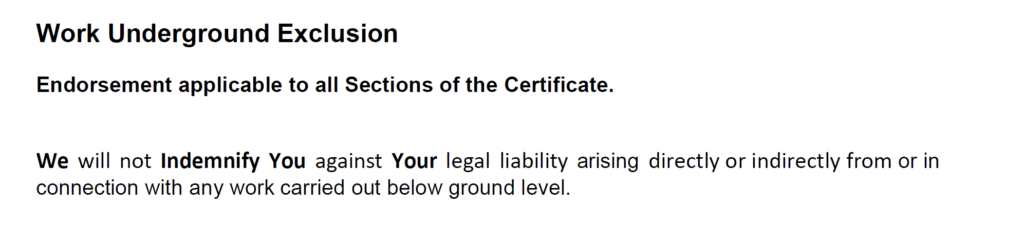
Even though that exclusion for seismic retrofitting work seems pretty obvious, it’s still easy to miss it if the broker doesn’t read the quote carefully. Sometimes the exclusions are even more subtle, like this exclusion, which is often buried on page 80-something of the policy:

The contractor who called us had purchased a cheap policy that his broker had found for him instantly, via a portal that did not ask too many questions. The broker did not review the exclusions before starting the insurance, and carelessly sold a low-priced policy that contained an exclusion for all kinds of retrofitting work. A few weeks later, when the contractor was reviewing his new policy, he discovered the exclusion and called his broker. Only then did the broker realize that the insurance he had sold was worthless. The contractor realized, to his dismay, that he had been operating essentially uninsured for the past three weeks.

We were able to fix this problem for the earthquake retrofitter because we are experts at construction insurance of all kinds. We always read through the policy language before we put a new policy into force, and we know which exclusions to look for. We also know which insurers specialize in specific areas of construction which are often excluded on standard policies, such as earthquake retrofitting, bridge work, utility work, new construction, and remodel work performed for large HOAs. We made sure that the retrofitter got a liability policy that insured his actual operations and did not include any worrisome exclusions, so he could continue with his jobs uninterrupted.

If you are an earthquake retrofit contractor, or any kind of contractor who has struggled to find proper insurance, please reach out. We can help with general liability, workers comp, commercial auto, bonds, and any other kind of construction-related insurance.

Most importantly, we will make sure the job is done right the first time.

How to find insurance for HOAs in California

The California insurance market is in a state of turmoil. A handful of big-name carriers are refusing to issue any new quotes in the state, while others are non-renewing existing clients. For small Homeowners Associations (HOAs), this can be a stressful time to seek insurance. Many HOAs (even those in urban areas) have been non-renewed by their long-time carriers, and must go out on the market for new insurance at a time when options seem limited and prices are rising. We can help! We specialize in HOA insurance in California, and can help non-renewed HOAs get new policies!

At Mighty Oak, our brokers understand how to navigate the nuances of a complex market, and the realities of shared homeownership. We understand that HOAs are unique, and as brokers we know how to properly insure them. Our master HOA policies include property coverage for the building as well as liability coverage for the HOA itself. We can also often add coverages like equipment breakdown, directors and officers coverage, sewer back-up, and crime insurance. Our goal is to match the coverages that are on the HOA’s current (non-renewing) policy. And for the individual condo owners who need insurance for their personal belongings, we work with insurance agents who specialize in personal insurance as well.

If your current insurer has non-renewed your HOA’s insurance policy, we will work to replace it with a policy comparable to what you previously had. If your price has risen considerably, we will work to find you a lower-priced quote. We can help even if your non-renewal is due to a history of claims. We work with insurers of all kinds, including those who specialize in “distressed” properties, meaning properties that have had a series of claims, and even currently-damaged buildings and buildings under repair.

Our brokers specialize in HOA insurance in California, Florida, Texas, Nevada, (and we are licensed in other states as well). We have been especially successful with HOAs in urban areas who have been non-renewed or whose prices have risen dramatically.

Indoor Grow Insurance

marijuana

As recreational and medical cannabis has grown to enjoy more legal status at the local and state level in the last decade or so, the industry has grown from a relatively small, largely underground status into a multi-billion dollar economic engine. From dispensaries to indoor grows, new businesses are cropping up all over the place.

More and more entrepreneurs and individuals are entering the Cannabis industry in various services and sectors, from industrial scale cannabis farming to wholesale brokering to retail and refinement. Inevitably, insurance questions arise as businesses are formed and business relationships take shape.

Up until very recently, the insurance industry lagged significantly behind the explosive growth of the cannabis industry. While many carriers still refuse to do anything cannabis related, we have cultivated a crop of insurers that specialize in Cannabis risks of all types, sizes and market share. We have developed our expertise in this field through meticulous research and experience with different types of businesses – expertise that you deserve as you work to bring your business online, or grow it to the next level.

Here are some of the industry sectors that we specialize in:

  • Medical Dispensaries
  • Recreational or Combined Med/Rec Dispensaries
  • Cannabis Tour Businesses
  • Cannabis Industry Consultants 
  • Edible Manufacturing
  • Oil Concentration Manufacturing
  • Harvesting Contractors
  • Indoor Grow Insurance
  • Outdoor Grow Operations
  • Potency and Purity Laboratories

Give us a call so we can get you what you need to get rolling.