

Apartment Building Insurance on the Bay Area Peninsula

Apartment Insurance Bay Area Peninsula

Finding apartment building insurance on the Bay Area peninsula—stretching from San Bruno to San Mateo and down through Silicon Valley—has become increasingly difficult. What was once a relatively routine line item for property owners has evolved into one of the most unpredictable aspects of multifamily ownership. Read on to learn why apartment insurance has become more challenging in the Bay Area, and how we can help you solve it.

The Apartment Building Insurance Squeeze on the Bay Area Peninsula

Here are some of the main problems owners of Bay Area apartment buildings face when they try to obtain insurance for their buildings:

A Shrinking Market

At the core of the problem is a shrinking pool of insurers willing to write policies in California. Over the past several years, major carriers have either exited the market or sharply limited new underwriting, particularly for habitational property risks.

This retreat is driven by a mismatch between risk and pricing. Catastrophic losses, especially from wildfires, have increased dramatically in California, while California’s regulatory framework has historically limited insurers’ ability to quickly raise premiums. As a result, many insurers have concluded they simply cannot operate profitably and have reduced exposure by declining new policies or non-renewing existing ones. For apartment owners on the peninsula, this means fewer quotes, longer placement times, and far less negotiating leverage.

High Prices

Where insurance is still available, it is often dramatically more expensive. Premium increases of 2–3x from year to year are no longer unusual, and some property owners report even steeper jumps. Part of this is due to rate hikes that have affected the entire industry, but that’s not the whole picture. The Bay Area peninsula is one of the most expensive places to live in America, and insurers raise their prices to account for that.

Additionally, high reconstruction costs in the Bay Area amplify insurer exposure. Labor, materials, and regulatory compliance all make rebuilding significantly more expensive than in other parts of the country, raising the stakes for insurers and pushing premiums higher. All of this leads to high prices for the insurance consumer (the apartment building owner).

Worse Coverage

Multifamily owners face an additional complication: even as premiums rise, coverage is often becoming narrower. Policies may come with:

  • Higher deductibles
  • Difficulty obtaining additional coverages like Ordinance and Law (often required by mortgage companies)
  • Exclusions for certain perils (water damage, wrongful eviction, habitability claims, etc.)

If the apartment building has older wiring or a roof in need of maintenance, the insurance options become even more limit. Many apartment buildings that used to be able to find high quality insurance for a low price are now forced to purchase a Fair Plan policy instead.

The FAIR Plan has grown rapidly, more than doubling in recent years. But it offers limited, bare-bones coverage and often requires additional “wrap-around” policies to fill gaps. These layered structures can be expensive and cumbersome, particularly for larger or more complex apartment buildings. For peninsula properties, many of which are high-value assets, the mismatch between FAIR Plan coverage and actual replacement costs can create significant exposure.

Navigating a Difficult Landscape

In this environment, apartment owners on the peninsula must take a proactive and strategic approach to insurance. Common strategies include:

Investing in building upgrades

One of the most straight-forward paths to obtaining lower-cost, high quality insurance for an apartment building is to keep up with regular maintenance. Most insurers expect that the roof, electrical, plumbing, and HVAC systems get renovated (or at least thoroughly inspected) every 25-30 years. Old and obsolete electrical systems (such as knob and tube, aluminum wiring, Federal Pacific breakers, Challenger breakers, Zinsco breakers) will force many insurers to decline, or offer high-priced policies. But if the building systems are up-to-date and well-maintained, even older buildings (built 1900, for example) can often get competitive insurance pricing.

Working with specialized brokers who understand multifamily risk

Our specialty is property insurance in California, specifically on the Bay Area peninsula (where we live). We are local experts who know the intricacies of the local insurance market. Our connections in the industry allow us to find insurers that other brokers don’t know about, and our intimate understanding of the Bay Area provides us with insight that out-of-state brokers lack. We know how to help Bay Area apartment building owners find the most competitive pricing, and we know how to help them keep their pricing low into the future.

Regularly re-shopping coverage in a volatile market

The market is always shifting, so it makes sense to shop around every year, especially if your pricing is high. Sometimes an apartment building has to take on an expensive policy due to deferred maintenance or a history of claims, but that doesn’t mean that owner needs to stick with the same policy forever. Each year we will shop around to make sure you always get the most competitive pricing. We are always looking out for the carriers that lower their rates, and we make the transition to a new insurer seamless.

Conclusion

The difficulty of securing apartment building insurance in the Bay Area peninsula is not a temporary disruption. Driven by climate change, inflation, and regulatory issues, the high prices reflect a structural shift in how the California insurance market functions. But we can help! Our core area of expertise is helping apartment building owners in the Bay Area peninsula. Our on-the-ground knowledge of the Bay Area and our deep connections in the insurance industry combine to make us the ideal ally for a building owner. We can also help Bay Area HOAs too!

Reach out today to get a quote!

Insurance for Non-Renewed Apartment Buildings

A record number of California apartment buildings have had their insurance non-renewed this year. Some big-name carriers are non-renewing every apartment building in the state. Though ultimately this turmoil is driven by the large number of recent wildfire claims in CA, apartment buildings in the heart of urban centers such as San Francisco and Los Angeles are being non-renewed all the same. Owners of apartment buildings can sometimes feel overwhelmed by this upheaval, especially if they’ve enjoyed stable insurance for the past few decades. If your apartment building has been non-renewed, what you need is a good insurance broker to help you replace that policy. We can help!

At Mighty Oak, our brokers understand how to navigate the nuances of a complex market, and the challenges of owning and managing multiunit apartment buildings. We understand that you face unique risks with tenants living in your building. Our apartment policies include property coverage for the building as well as landlord liability coverage. Our goal is to match the coverages that are on your current (non-renewing) policy, help you protect your investment, and satisfy your lender. And for the individual renters who need insurance for their personal belongings, we work with insurance agents who specialize in personal insurance as well.

If your current insurer has non-renewed your apartment building’s insurance policy, we will work to replace it with a policy comparable to what you previously had. If your price has risen considerably, we will work to find you a lower-priced quote. Along the way, we are happy to offer advice and guidance for steps you can take to lower your future insurance costs and widen your insurance options. We can even help if your non-renewal is due to a history of claims. We work with insurers of all kinds, including those who specialize in “distressed” properties, meaning properties that have had a series of claims, and even currently-damaged buildings and buildings under repair. We have options to insure apartment buildings of any size, and can even find you a quote if you (the owner) occupy one of the units. 

Our brokers specialize in apartment building insurance in California, Florida, Texas, Nevada, and we are licensed in other states as well. We have been especially successful with non-renewed apartment buildings in urban areas, and apartment buildings facing a steep insurance price increase.

Contact us today to speak with a broker!

(We also specialize in finding insurance for non-renewed HOAs).

How to Properly Insure a Mixed Use Apartment Building

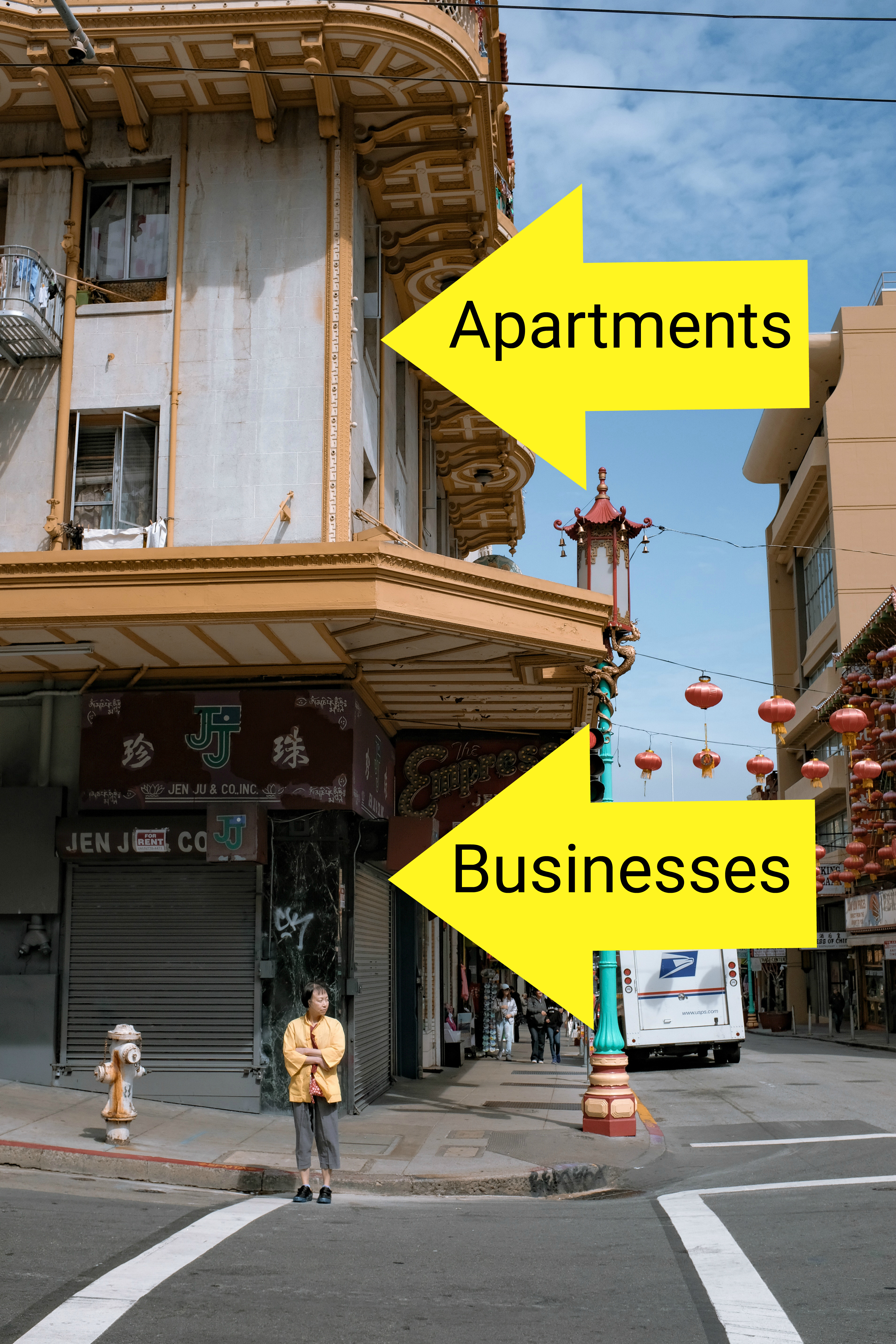
A mixed use apartment building in Chinatown, San Francisco

What is a “mixed use” property?

A building is “mixed-use” if it has businesses on the street level and apartments up above. Really, a mixed use building is any building that serves multiple functions. It might be part office and part retail, or part government building and part cafe, or part residential and part commercial. Walk around any major city – such as San Francisco – and you’ll see these types of buildings everywhere, especially mixed use apartments. Here at Mighty Oak, we specialize in mixed use property insurance.

Another mixed use apartment building in Chinatown, San Francisco

The Challenge of Insuring Such a Building

Mixed use apartments, which generally feature apartments on top and businesses on the street level, are ubiquitous in San Francisco. They also happen to be a real pickle to insure properly. Every occupant of this building needs a different kind of insurance: the business owner needs to insure his business, the residential tenant needs to insure his belongings, and the building owner needs to insure the entire property.

In the event of a disaster like a fire, it is crucial that all three of those areas (business, tenant’s belongings, and the building itself) have policies that will pay out! Often times the business owners, tenants, and landlords aren’t entirely clear on which types of insurance they actually need, or what it means to be “properly covered”. For example, if a building owner insures his building, it is important for the business owner tenant to understand that his business property is likely NOT covered at all.

Often these buildings contain many different tenants and businesses that each have their own unique insurance needs. It is absolutely essential to work with a competent insurance broker who can provide insurance options for the business owners, the tenants, and the landlord. Ideally this broker could also educate the whole crew on which occupants are responsible for which insurance pieces.

This iconic corner in North Beach, San Francisco is full of mixed use apartment buildings.

How to Properly Insure a Mixed Use Building

First, we should consider the building itself. Each building needs to have its own Landlords Policy, which will cover the actual building. As the name of the policy implies, this piece is the landlord’s obligation to purchase (and it is the landlord who gains the protection). If the building is damaged or destroyed, this policy will pay back the owner of the property for repairs. Sometimes when an older building is damaged, the city steps in and demands that the property be brought up to code (such as a mandatory earthquake retrofit). This insurance policy can help cover that cost as well. It will even cover lost income, since the owner may lose some rent payments if tenants have to evacuate during repairs.

This policy is crucial for the owner in other ways. For example, if a visitor slips in the stairwell and decides to sue the property owner, this policy will pay the legal bills and damages. If a tenant decides he’s been wrongfully evicted and chooses to sue, this policy may cover the landlord’s legal fees. In other words, the building is the landlord’s business, so it should be insured in almost all the same ways a business would be insured: protect the property itself, protect the owner’s income, and protect the owner from lawsuits.

A typical mixed use property, with apartments upstairs and a bar downstairs. The owner must insure this entire property, since he owns the whole building.

Now that the building itself is covered, the rest of the building’s inhabitants (both residential tenants and business owners) need their own separate insurance. Take the example below: we see that the red units are residential units and the blue units are retail commercial units.

Each occupied unit needs its own insurance coverage. But wait – haven’t we already insured the building? Why should each tenant have to insure their own unit? Actually the tenants do not need to insure any part of the building itself, but rather their own belongings inside their unit. The Landlord’s Policy will not cover any of the tenant’s belongings, and in the event of a fire, the tenant will not be reimbursed for lost items unless he carries his own separate Renter’s Policy.

A Renter’s Policy is also known as “contents coverage”, or insurance coverage that does not cover the structure itself, but instead the contents of each unit. Every residential tenant can cover his own belongings without having to pay for coverage for the building that he does not own. These policies are designed to protect the tenant in case something like a burst pipe destroys their belongings. A good Renter’s Policy can even cover a tenant’s liability, say if the tenant accidentally starts a fire that destroys the neighboring tenant’s belongings. The combo of a Landlord’s Policy and Renter’s Policy ensures that the building itself and all the stuff inside it are protected from accident or disaster.

What about the businesses on the ground floor? They are also tenants, but they don’t live in their unit. These commercial tenants need policies that cover their:

Business Property – Covers their equipment, tools, and other contents of the commercial unit, in case they need to be replaced after an accident or disaster.

General Liability – Covers the business owner in case a customer gets injured or someone else’s property is damaged during the normal course of business. If someone slips inside the business and decides to sue the business owner, this policy will pay his legal bills.

Workers Comp – If an employee is injured on the job, this policy will pay the medical bills. This type of insurance is legally required for any business that has at least one employee.

Just like the residential tenants, these business owners do not need to cover any part of the building itself, but only their own businesses inside their unit

This is why a mixed use property is the perfect intersection of personal insurance and commercial insurance, all in one property. A good broker can work with the entire building to cover the owner and every tenant in a way that protects everyone without forcing anyone to pay for insurance they don’t need.